Search This Blog

Tuesday, March 11, 2014

SMART Goals for Smart Women

Welcome back to another week of Women’s 
Weight Training Web Edition.

       This week’s topic is goal-setting, which I wanted to talk about since all of you are here for a reason. We set goals because we want something, but merely writing your goal down is not enough to achieve your goal. You must do a few other things as well.

Intent

What is your intent?

Do you intend to sit on the coach and wish your goal would come true? Do you intend to lose 25 pounds in 40 days? Whether you tell your goal to yourself, a friend, or you write your goal down you must have the intent or determination to go after your goal if you want to ever achieve it. Additionally, your goals should be SMART goals.

Motivation

       Your motivation (what is driving you to behave in a particular way) will affect your intent. Motivation can be tricky because different things motivate us and if the wrong things are motivating us then our intent to do something may only last from a brief moment to a few days.

Let me give you an example of how motivation affects our intent to exercise:

       There once was a girl who wanted to go to Florida with her friends for Spring Break 2014. Her and her friends would sit outside on their lunch break and talk about what they would do to get skinny for their trip to Florida. They agreed they would work-out for two weeks 7x/week with no rest for two hours a day and do abs every day. She didn’t really like exercising because she never saw the weight-loss results she wanted, but she knew she could stick to a short-term exercise routine, especially because her friends were doing it with her.

       This example is a great example of how and why we fall off the band wagon. These young ladies are determined to exercise for two weeks straight at an ungodly pace and effort because they believe they will be rewarded. The ultimate reward for them is to be skinny, look good in a bathing suit, and possibly attract attention.

       When we are externally motivated, that is, our behavior is regulated by the fact that we feel we will be rewarded, we feel coerced or obligated by someone or something, we are less likely to stick to that behavior and to enjoy it.

       Even if you are externally motivated, it is still quite possible to achieve your goals! Remember I said something about setting SMART goals? SMART stands for specific, measurable, assignable, realistic, and time-related. To break this down for you so that you can see how this can be done, I will use an example which you have given me from Women’s Weight Training.

Goal: To do 10 un-assisted push-ups by May 31st.

Let’s turn this goal into a SMART goal:

Specific: She wants to do 10 un-assisted push-ups by May 31st.


Measureable/Meaningful/Manageable: 10 push-ups by the end of 2.75 months.


  • This goal largely depends on the person’s fitness level. For someone who is just beginning a fitness program, 10 quality un-assisted push-ups within 2.75 months would take some work. They would need guidance, a balanced routine, and to be building up [both] upper body and core strength prior to performing even one quality un-assisted push-up. Progression is important and many people become impatient with this. Remember the girl who didn’t see weight-loss results? She became impatient, she overworked herself, and did not follow a progressive routine. 


       In my previous experience, I would begin by starting out with push-ups on the knees until my client could do proper form for at least 10 knee push-ups. Then we would progress to incline push-ups on a bench until she perfected those for at least 10 push-ups. Once this was accomplished she would move to regular push-ups. Nevertheless, she would be working on core strength, bench press, shoulders, triceps, back, biceps, and even lower body throughout her program.

Assignable/Achievable/Attainable:


  • Again, this depends on the person, their level, skill, ability, or talent. Look at the time-frame you have assigned yourself. Losing 25 pounds in 40 days is not attainable nor would it be healthy. For someone who only needs to lose 5 pounds, a 25 pounds weight-loss would not be attainable. For someone who is 40 pounds overweight, a 25 pound weight-loss would be attainable, but not in 40 days because a healthy weight-loss is estimated around 1-2 pounds per week, not per day.


Realistic/Result-based:


  • You will see that many of these relate to one another. Progressive goals will allow you to see tangible results. This may take up to a few days depending on how much you practice to a few weeks. You can track your progress with a journal or notebook. Tracking your mood is another great way to see how your exercise progress affects you. We often don’t realize that while we are working toward our goal, there are many other processes at work too such as psychological processes and it is important that we reflect on how our thoughts play into our emotions. When we don’t see results we tend to get frustrated and want to give up. Practicing breathing techniques during this time period can help to alleviate some of the stress associated with trying something different from what you’re used to. If you set realistic goals and you’re following through with them, trust in the process!


Time-bound/Time-related:


  • How can we reach a goal if it is endless or we don’t know when to stop? When we don’t have goals we aim at nothing, but when we have goals we aim for something. Thus, it is important to set a time-frame, even if you have to readjust. Readjusting is part of being self-aware of what you feel and what your body is doing or becoming. Readjustment must not be mistaken for failure. When you set a realistic goal and a time-frame that is also part of that realistic goal, you are working toward what you want, right? Failure is going to be part of the learning process. However, if you fail to look at this time as a time to periodically adjust you won’t improve. Instead, you will just stay stuck, feel guilt, shame or disappointment, and ultimately fail to move on. Failure is part of improving!


So there you have it. Goals help pull us in the direction we want to go. If we didn’t have goals we would aim at nothing. I suppose that’s not a bad thing, but sooner or later, we want to go somewhere.

Everyone has different motivations for what they choose to do. These motivations affect us in different ways and can leave us feelings overwhelmed, tired, or on the other hand, very happy. Setting SMART goals will help you discipline yourself wisely so that you can achieve your goals no matter what is motivating you.

Determine what is motivating you today to achieve your goals. Remember that it is okay to readjust. I have posted your short-term and long-term goals. Use the SMART goals format to adjust and think about your own goals and how they might influence your intent to exercise or your overall health. Are they realistic? Is there something more you can do to make it attainable? 

Feel free to email me and ask me any questions you have! 


 “Whether you think you can or you think you can’t, you’re right.” –Henry Ford

Monday, March 3, 2014

The Importance of Nutrition


Good Morning and Happy Monday! 


I've been asked if I could give out some of my recipes for clean eating., but first you should know why some of the ingredients in my daily diet are part of my own routine and how they may benefit you in your health and fitness endeavors.

What are macronutrients? 


It is important to remember that while we are doing all this hard work in the gym, we cannot neglect to fuel our bodies with proper nutrients like protein, carbohydrates, fat (the good kind of fat), and water which are important for growth and regeneration. These are called macronutrients, which can be found on food labels on most food items. Whole foods such as vegetables and fruits will not have food labels.

Food Labels 


Food labels will tell you the serving size (how many servings are in one packaged item) and how many calories are in that serving size. It will also tell you information like: how much protein is in a serving size, the amount of fat (which will also be broken down into transfat, saturated fat, monounsaturated fat and polyunsaturated fat), how many carbohydrates are in the serving size and how much of those carbohydrates are from added sugars. Other things to keep in mind while reading food labels are the fiber content. Fiber is a type of carbohydrate, but it does not get absorbed by the digestive tract. Insoluble fiber ("Fiber" listed on food labels does not have any calories in it and is good for digestion. It will help to keep you feeling fuller for longer periods of time. 

Protein 


Protein is an important building block for the muscles. During weight training you are breaking down muscles which need replenishment within a certain time frame afterward. If we starve our muscles for too long after our workout or before our workout then our muscles get hungry and we may not see the results we desire. Protein is also great for keeping our blood sugar stabilized. Too little protein each day can make us feel weak, tired, and fatigued. There are at least 20 different types of proteins in the body. Some proteins take longer to break down by our digestive tract than other proteins such as chicken or beef protein vs. milk (whey/casein) protein or protein in an egg. You should get a variety of sources of proteins from your diet which can come from animal protein and plant proteins. 

Carbohydrates


Carbohydrates can either be complex or simple and is a nutrient source for energy. Sometimes it is hard to tell the difference. Complex carbohydrates are those that are typically rich or abundant in fiber, vitamins, and minerals such as fruits, green vegetables, wholes grains, starchy vegetables like sweet potatoes and pumpkin, beans, lentils, and peas. Look on food labels to see what added sugar content. Choose foods that have less than 15 grams of added sugar in them per serving and be mindful of how many servings per package you are consuming. Consuming 2 servings of something that has 15 grams of sugar in it means that you're really consuming 30 grams of added sugar (table sugar!) which means... (see picture).

Fats


Fats also come in all shapes and sizes and is a nutrient source for energy. For example, there are trans fats (which should be avoided at all costs), saturated fats (which can't always be avoided and should not always be avoided), monounsaturated and polyunsaturated fats. Each type of fat differs in its molecular shape and how our body reacts to that is different as well. Sometimes these fats are hidden in our food, but if you check food labels you can gain a better sense for how much is in a serving you're about to consume. Trans fats are man made and are difficult for our body to process. Think of it as eating rubber, you wouldn't do that would you? Saturated fats can come from a variety of sources of food such as animal and plant proteins. There has been extensive evidence that saturated fats can increase your risk for heart disease. However, there's a new debate that it may not all be bad (you've heard the benefits of coconut oil which is high in saturated fat?). It's important to limit the amount of saturated fat you eat and consume enough of the monounsaturated fats and polyunsaturated fats which can be found in nuts and seeds, egg yolks, fish, sunflower oil, olive oil, and avocado. These fats are metabolized much faster and used for energy. 

Nutrient Density Example


A good rule of thumb is to ask myself "is this food item nutrient dense?" which means that it would contain more vitamins and minerals,  protein, good fats, fiber, and carbohydrates compared to the total number of calories in a serving size. 
For example: a Subway 6" turkey breast sub (not including cheese or vegetables) (serving size) has: 
290 calories (per 6" serving)
4 grams of fat (1 gram saturated, 0.0 grams trans fat) 
46 carbohydrates (7 sugars) 
5 grams dietary fiber
760 mg of Sodium
17 grams of protein 
Iron - 20%, Vitamin C - 20%, 

Compared to: a Subway 6" chicken and bacon ranch melt (including cheese or vegetables) has:
500 calories (per 6" serving)
23 grams of fat (7 grams saturated, .5 grams trans fat)
46 grams of carbohydrates (8 grams of sugar)
5 grams of fiber 
28 grams of protein 
1030 mg of Sodium 
Iron - 15%, Vitamin C - 15 % 

As you can see the fat content (and saturated fat content), and sodium are all very high for this second serving size compared to the fat content of the Subway 6" turkey breast sub. The sodium content is also very high for the second example. Although salt adds flavor, too much of it can increase your risk for developing high blood pressure, diabetes, and stroke. 

Be Wise 


It is wise to go for foods that are whole foods and contain little to no ingredients list, that is not always possible in today's society. Make wise choices, which can be done using food labels and common sense. Fat and carbohydrates are energy sources so we should be keeping a balance between the two. 

Would you run for an hour and then go weight train for an hour when you had a million other things to do that day? Would you eat an entire avocado and then go eat an entire chicken breast? These might sound like silly questions, but my point is that you need to find the right balance between fat and carbohydrates, which are both great sources of energy. An avocado is composed of all fat, good of course, and chicken is mainly protein. It is not necessary to eat an entire chicken breast because it contains A LOT of protein (1 oz. of animal meat contains approximately 7 grams of protein). Macronutrients can be eaten together or separately, and both fat, carbohydrates and protein are often found in the same foods (such as nuts which have a combination of fat, carbohydrates and protein). This is why nuts make a great snack! If you are eating a meal high in carbohydrates such as fruit, whole grains or vegetables, limit the amount of fat in that meal (don't eliminate it because your brain, joints and nerves need healthy fats!). The same goes for the opposite, if you're eating a meal high in fat such as a salad with nuts, avocado, and oil-based dressing, limit the amount of carbohydrates (energy) you have with it. Too much energy intake will lead to your body storing that energy and if you aren't utilizing that energy (burning it off) then it will be stored as fat. 

Tips: 


Drink water first thing in the morning.
Drink water frequently throughout the day to aid in digestion and metabolism. 
Eat at least three balanced meals throughout the day.
Don't skip breakfast. Sip on a nutritional shake throughout the morning if breakfast isn't your favorite.
Pack healthy snacks for the day like cut-up vegetables, whole grain crackers, hummus, nuts, and fruit for times of low-energy. 


Tuesday, February 18, 2014

Phases of Development

Congratulations ladies for making it to week 5!


       You have dedicated an hour each week to coming to class and sacrificed a potential break in your busy schedules to get sweaty and exercise in order to learn a variety of new exercises that you will eventually be doing on your own.  

 setting path to goal       Not only can learning something so complex as exercise programming be confusing, but it can be hard learning something you don’t particularly understand quite yet. There are many “pieces” to the “puzzle”. In today’s environment, we have been given quick fixes, but none of the health, fitness, or weight-loss entities that have been claimed to be unlike the others have really delivered what we have been looking for. There is no solution like exercise!

       I realize there comes a time when I must use my expertise not just to teach you, but to help you apply these skills to your own every day lives. I have created a PowerPoint, which I will send each one of you individually so that once you read this blog post (primarily a refresher of what was said in class) you will better understand how to create a routine based on your own personal needs. The PowerPoint includes a scenario, an example of a linear design, an alternating design, a routine designed for strength, and a routine designed for building lean mass and keeping the intensity high. 

Slow down. Calm down. Don't hurry. Don't worry. Trust the process. 


       I want to take some time to sum up what we have accomplished and some things you have learned these past five weeks. If you have questions, please ask!

We have covered exercises working various muscle groups such as:
  • CHEST

a.       Main muscles: pectoralis major, pectoralis minor, serratus anterior
  •  BACK

a.       main muscles: latissimus torsi & teres major, trapezius, levator scapulae, rhomboids, infraspinatus & teres minor, subscapularis

These muscle groups are opposing muscle groups or OPPOSITE muscle groups.  
The chest muscles push, while the back muscles pull.

We have also covered:
  •       TRICEPS (triceps are complimentary to chest, they are activated during many chest exercises)

  •      BICEPS  (the biceps are complimentary to back, they are activated during many back exercises)

These muscle groups are opposing muscle groups or OPPOSITE muscle groups.
The tricep muscle pushes, while the bicep muscle pulls.

       During one class, I had you combine chest and back together (opposing muscle groups).During next week’s class we will combine…can you guess? Biceps and triceps! …oh and abdominals.

Where are you now? 


       Remember that you are still in the learning phase. You are learning how to lead a dynamic warm-up ON YOUR OWN! You are learning how to properly execute these exercises on your own and many of you are experiencing these exercises for the first time. It can be intimidating, but I’m on your team and supporting you the entire way!

If you remember back to the second week when I had you write down some of your thoughts about what you learned about yourself at the end of the class, this activity was meant to get you to think about how your thoughts affect how you feel and behave. Check up on your thoughts daily. Negative thoughts cause us to feel shame, guilt, angry, frustrated, and so on.

Is it scary trying some of these new exercises in class? It should be. Any new experience takes courage, but you are honest and will benefit tremendously! Think of this as personal growth. Take time to breathe, plan ahead, and become more aware of your body.

This week and next week:
  •  Try a dynamic warm-up on your own.

If you forget some exercises there is a book on the counter labeled “Dynamic Warm-up Exercises” which can be a great refresher and educational tool!
  •  Define your goals.
Do you want strength gains? Do you want muscle hypertrophy (growth) and lean muscle mass? Do you want intensity while decreasing the time spent lifting weights?            
o   Take longer rests for increased strength gains.
o   Integrate supersets and drop-sets for added intensity.

o   Increase to 3 sets per exercise at the moderate-advanced fitness level. 1 to 2 sets for beginner.
  •  Create ONE daily routine based upon the exercises you have learned.

This is NOT an exercise program. A program would include a planned series of workouts consisting of daily exercise routines. We are not there yet because we have not learned lower body exercises or shoulder exercises. Thus, we cannot create a balanced program.
  • While creating this routine be thinking about combining opposite muscle groups OR complimentary groups of muscles. (Keep in mind we have not learned shoulders or low body)

This can be done in an alternating fashion or a linear fashion whilst keeping in mind you want to work with both compound exercises (larger groups of muscles) and isolation exercises.
  • Choose between 6 to 10 exercises for your routine and perform 2 to 3 sets.

       Now that you have looked over this, you're probably still confused. This will make better sense once you check out the PowerPoint. We are still learning many more exercises for the next several weeks (Women's Weight Training goes until May)! 

Tuesday, February 4, 2014

Women's Weight Training: Week 2

Hello Ladies! 

Welcome Back to Women's Weight Training: Week 2

Personal Empowerment & Self-Awareness.


I really wanted to tailor this program around you because, well, it's all about you and your needs related to health, quality of life, and fitness. In order to make this more personal I needed to know what some of your strengths and weaknesses are. 

In this past week's activity I asked that you take a few seconds throughout the class to observe the thoughts, feelings, or beliefs you had about yourself or others as you worked out. Then... I asked you to tell me what you learned about yourself this past week as it related to the thoughts you had during the class...


This task served the purpose of discovering essential knowledge about yourself that will help you break out of ruts causing you to make the same mistakes over again (Do you remember last week talking about barriers that cause you to skip the gym?). This is also called SELF-AWARENESS. I assume that as much as you want to learn weight training that you also want to learn what it takes to be exceptional in all areas of life...work, family, social, spiritual, and exercise. Let's take a few moments to assess what you were thinking.
 

Here's what you learned about yourself this past week:
  • "The instructor concentrated more on form and accuracy vs. how many [repetitions] you could do. There were some exercises I thought I could not do and did. Yay!" 
  • "Breathing helps me keep my mind focused and push through [lifting weights]."
  • "Concentrating on breathing helps get me through a set. I can push myself harder/further with internal motivational thoughts."
  • "Some days it feels great to work alone in the office and not be responsible for others. [Every once in a while] To do the tasks I like best rather than delegate those and stick with the mundane!" 
  • "I hate waiting between sets."
  • "A rough night impacts your ability to focus on your workout."
  • "I am stronger than I think (but I tell myself I am not)." 

And This Matters, Why?


So how does what you said relate back to helping break out of the old routine that is causing you to lack the results you want: physically, mentally, and emotionally?  In this activity, many of you became aware of your own potential to be better than what you previously thought you could be.

 "I am stronger than I think (but I tell myself I am not)." 

Another example of this was...

 "There were some exercises I thought I could not do and did. Yay!" 

I automatically noticed some things that stand out to me as being potential threats to personal improvement. I want to acknowledge the fact that you did take the time to do this activity because this will benefit your own personal growth. There is no room for negativity in personal improvement. There is, however, room for mistakes. 

It's Okay To Make Mistakes.


As humans, we tend to focus on the negative because that is our nature. Negative thoughts will leave us in ruts, not the actual mistake or failure itself. Our thoughts affect how we feel and how we feel affects how we behave. To put it another way, when we think we can't do something and we're asked to do it, we feel scared. We lose confidence and we don't do it, unless I make you of course! But what happens when I'm not there to push you out of your comfort zone? 


What If I fail? 


Failure is crucial for personal development because it teaches us humility. When we make a choice there are always going to be consequences (both good or bad) that come with it. How you assess the situation (what happens after you make a choice) will determine whether you improve or do not improve. For example, one of you wrote, 


"A rough night affects your ability to focus on your workout."

How you assess the situation (was what happened good, bad, just okay?) will determine whether you adjust your behavior the next time you prepare to make a decision. But, if you perceive failure as a bad thing then you've already begun the cycle of negative thinking. 

Be Your Own Coach.


You will not always be able to try something before you know you can do it, so positive thinking is important because you need to be your own encouragement. If a coach told you to go out and try something, but you're probably going to suck at it would that make you feel good? Or if your boss told you that you were terrible at writing up reports, but you were the only one to do the job so you need to do it, are you going to feel good? You are your own boss. It is a scary world out there, and you might not always know what's on the other side, but think "Fake it till you make it". Your positive thoughts will pay off!


Finding Purpose.


I suggest having a purpose every day or a goal to set out for. This will make it a little easier to persevere through difficult times or sets that are challenging.

If you are joining women's weight training on a regular basis this semester, ask yourself why you're joining. If you're joining to learn a few new exercises here or there then this is probably not the place for you. If you're joining to learn how to take responsibility for exercising on your own and increase your self-confidence then you're here for the right reasons. 


Self-control Is A Process.


That's not to say learning how to take responsibility is easy, but in the process you will gain self-control if you put the effort in to assessing your own thoughts and feelings.  

Do you remember crying your eyes out when your mom dropped you off at preschool and you didn't want her to leave? You had to learn to be independent one way or another. She didn't like leaving you there, but she had other things to do. My vision is that you can take control of your own body, mind and emotions. 


It's difficult for me to watch you struggle, but I can see the improvements already. This class is forcing you to ask questions that you wouldn't have if you were copying everything I was doing in group fitness. 


How To Improve.


We know now that negative thinking is the culprit to a lot of the psychological and physical ruts we get in. 

There are a few positive examples above I'd like to mention that I felt were on-point for gaining control of your body, which will lead to body control, and skill control. This method, ultimately, will affect your thinking, feelings, and the way you behave across all situations, but it must be practiced throughout the day every day. 

  1. Breathe. "Breathing helps me keep my mind focused and push through [lifting weights]."
  2. Positive affirmations. "I can push myself harder/further with internal motivational thoughts."
  3. Take responsibility for yourself. Control the things you can control. Let go of what you cannot. "Some days it feels great to work alone in the office and not be responsible for others. [Every once in a while] To do the tasks I like best rather than delegate those and stick with the mundane!" 
By becoming self-aware of what you're thinking and feeling you then can take responsibility for the way you behave the next time. Our behavior is a choice, which begins be the way we think. Perception is the greatest freedom.


Last week we covered resistance training the back muscles. 

Here's what we did:


Warm-up: 5-10 mins cardiovascular work on elliptical or treadmill followed by 4-5 dynamic stretches
1). Assisted Pull-ups- Narrow grip
  • activates biceps and back
  • aka easier/safer than wide-grip pull-up

2). Inverted row on Smith Machine 
(reverse push-up)
  • also an advanced exercise
     *Consider these part of the same "Group" 
3). Cable Lat Pull-down


 (on one-knee) 
     *Consider this part of the same "Group" 
   
4). [Overhand] Barbell Rows
5). Underhand/Reverse Grip Barbell Rows
  • activates biceps

6). Dumbbell Row 
Both arms *saves time
Alternating
       *Consider these part of the same "Group"

7). Modified Plank Row
        *Total body exercise works core & upper back

Monday, January 27, 2014

Overcoming Barriers to Fitness

Week #1

BARRIERS TO EXERCISING

Here’s what women from WWT said their number one barriers were…

  • Getting started, staying focused.
  •  If I don’t go to a class or have a plan to workout.
  •  Motivation, aches and pains.
  •  Motivation & time to get started.
  •  Myself- class, tests, desserts -> priorities & self-control
  • Time.
  • Cold weather.

#1 Barrier to Exercise: Time

What you can do…

  •          Shoot for at least three days a week in the gym.
  •         Plan ahead. Yup, you’ve heard that before. Blah, blah, blah. First of all, if you’ve got children remember it is important to take care of yourself too. This means “mommy” time. You wouldn’t tell your child “make sure you take care of others before yourself, honey”. At least I would hope not. You’ve got to be a role model, which means setting by example.
  •          Get a calendar out and plan off where you can fit in potential workouts during the week.
  •          For those of you whose schedules don’t match up with group fitness classes, go on in to the Wellness Clinic and try a workout on your own! The staff can make on-the-spot workouts for you while you warm-up. Just tell them what you’d like to work on that day and they will even guide you through it.
  •        Lunch breaks are a wonderful time to rev up your energy in the Wellness Clinic when you’re feeling sluggish from sitting at your desk all morning. Go for a walk…it will be getting nice out in just a few short months!
  •          If you know you’re not a morning person and you’re in a rush in the morning, keep a locker with a spare change of clothes in it at the Wellness Clinic OR pack your bag the night before and leave it by the door so that it’s all set to go in the morning.                                               
  •          Remember that if you don’t get in your workout as planned on your schedule, it’s not the end of the world! You can get small bouts of exercise in and make it count toward your weekly goal. After a long day your mind feels tired and groggy. It’s hard to think and the last thing you want to do is move your body, but did you know that’s the best thing you can do for it?! Start with 15 minutes of light-moderate cardio after a long day of work and see how you feel before you head home.
  •         Pack snacks in bags like fresh veggies and hummus or nuts throughout the day to keep you satisfied. You may have to sacrifice a lunch period for eating lunch while you do work. As long as you keep lunch healthy, mindless chewing isn’t so bad!

#2  Barrier to Exercise: Getting Started

Getting started, not having a plan, motivation

What you can do…

  •        I said this for barrier one, but I’m going to say it again…get a calendar out and plan off where you can fit in potential workouts during the week. Getting started is quite difficult, especially if you feel you lack motivation. If you’re purely exercising to lose weight and look good then it may be more difficult to stay motivated in the long-run.
  •       Shift your mental focus from “I hate exercise” to “This isn’t as bad as it seems”. Remember, let’s take baby steps. You don’t have to LOVE exercise, but you can learn to like it. Exercise can be fun (no really, when you do it right your body releases endorphins creating a euphoric state of mind). However, merely driving to the gym is not enough to produce those effects, so we must move.
  •      Have a playlist that involves songs you can jam out too!
  •      Set an exercise contract with yourself. It may look something like:
Exercise Contract Example 1

I, __(Name)__, hereby make known to, ___(Name)___, that from this day forward I will go to the gym at least three days a week for one hour. I will not make up excuses such as “I’m too sore” or “I’m too tired”. Sick days are regarded as excusable.
If I reach my goal by ___________(date must be at least four weeks out from today), I will let/give myself __________________________________________________________________(reward).
 
Your signature, __________________________________________
Witness signature,_____________________________________________

Exercise Contract Example 2

I,___(Name___, hereby make known to, ___(Name)___, that from this day forward I will strive to be more aware of the negative things I say about exercise. For every negative thought my goal is to say 3 positive affirmations.

Keeping Progress

I will keep track of my progress with a positive affirmation jar. When I get 100 positive affirmations in my jar, I will let/give myself_______________________________________________________________(reward).
   Your signature, __________________________________________
Witness signature,_____________________________________________

  •         Sometimes telling others that you want to do something can help get the “juices” flowing. Change takes time, and making consistent healthy lifestyle choices takes just that, constant effort. It is a journey that should be enjoyable when we do it for the right reasons. Don’t let anyone stop you from doing what you need to do. If you fall down, get back up again!

# 3 Barrier to Exercise: Stress

Cold weather, class, tests

Stress is something that creeps into our daily lives and we don’t recognize it until it’s too late. There is good stress believe it or not! It’s called eustress and we feel that when we go to amusement parks, eat cotton candy, go on a date, try something for the first time we’re excited about, or get married! But, bad stress can wear us down…

When bad stress strikes we’re always thinking negatively. This one comes down to how we view the world and it’s been my experience that it is human nature to react 9/10 in a negative way. How can we look at things differently in order to lower stress?

What you can do…

  •          Breathe. Deep. Breathe deeply. Take a giant deep breath in, send it down to your belly and release it. Ahhhhhhh.
  •          Start your day off right with a balanced breakfast.
  •         “I can do it.” You can do it. Because I believe in you, and you believe in you. It’s amazing what happens when you just believe and let go of the things you cannot control.
  •         Take control….This may send you back to the first bullet, but BREATHE. Take some nice deep breaths because if you’re focused on your breathing you can’t focus on anything else. The principle of dominant thought even says so…
  •      Prepare ahead of time. This may be the best you can do and sometimes there are still things that will come up and unexpectedly mess up your day. Be prepared to handle change and conflict with patience and acceptance.
  •       Now, think positive. What do you want to happen? That’s right, you want to be happy, fulfilled, successful, strong, courageous, better, etc.
  •          Close your eyes and envision this outcome every day because eventually it will happen for you.
  •         Youtube.com has many wonderful and FREE guided meditations to help calm your senses. Choose a quiet time such as just before bed or the middle of the day to listen to one. Key terms such as ‘healing meditation’ and ‘guided meditation’ will help narrow the search.
  •         Do something that you enjoy doing even if it’s just for an hour each week such as reading or volunteering.     
  •        Drink plenty of water and get at least 7 hours of sleep at night. 

#4 Barrier to Exercise: Staying Focused


Self-control, priorities

We are so involved in other’s lives because we’re social-relational creatures. It’s difficult to stay focused when we’ve got so many demands coming at us and tasks we’ve got to get accomplished. It’s to be impulsive when others are doing what they want to do and there’s social influence all around us.

What you can do…

  •          Turn off your cell phone and any other electronic devices while you’re working. If you can’t turn them off then turn them on silent and set them aside.
  •         Set aside breaks every 30 minutes to check your devices.
  •         Keep a journal of what is most valuable to you. Write down your goals and what you will do to get there. Then, track your progress and check in on yourself to see if what you’re doing is in line with what you say. We often times feel unhappy because we’re not doing what makes us happy.
  •          Lose Control. Know that it’s not possible to be in control all of the time. Give yourself credit for the work that you do!
  •          At the end of the day, go over what you have done instead of focusing on what you haven’t done. This may help you to see that you likely have been self-defeating yourself with negative thoughts by thinking things like “I haven’t gotten anything done today” or “I missed a workout”.
  •         Ask yourself what you want for yourself, then go do it for the rest of your life. 

Saturday, January 25, 2014

Women's Weight Training: Week 1

Welcome Ladies!

This week's weight training program was meant to teach you some basic and well established chest exercises among free-weights and barbells. 


Here's a re-cap of what we accomplished...

Warm-up 5-minutes on the treadmill or elliptical
*All Repetitions between 8-15 for 2 sets. 
1) Flat Chest Press -> with dumbbells                          
2) Flat Chest Press -> with barbell 
3) Incline Chest Press -> with dumbbells
            * Think of these three exercises as being in the same "Group". 


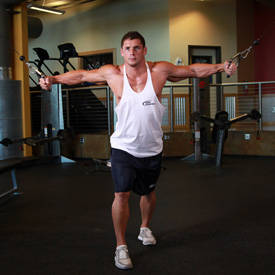
4) Chest Fly -> mid-cable crossover                                   
5) Lying Fly -> with dumbbells on a bench
                * Think of these two exercises as being in the same "Group".

6) Push-ups


CHEST TIPS

  • Incline will hit your upper pecs slightly more than flat bench chest-press. (This is slightly above the breasts)
  • When performing the dumbbell chest press, have your arms bent at a 90 degree angle at your elbows so your weights don't begin to tip in and consequently fall on your head.
  • Always be aware of what your muscles are FEELING! 
  • Don't get so consumed on counting repetitions that you forget your muscles are fatiguing! 
*Keep in mind we did not cover Close-grip Chest Press or Reverse Barbell Chest Pulls.

What Next?

       Many of you are probably wondering "what is next?". Your chest may be feeling sore after last week and the rest of your body is lagging behind. Women's weight training is a semester-long class to teach you all the exercises you need to know along with how to put them together to be able to train on your own. 

       Unfortunately, we all want to know how to do this in one 50 minute class. You want me to tell you the magic recipe for getting the best body ever and increasing your motivation, but I will tell you my secrets if you stick around long enough to listen. 

       Many of you will not stick around because it's too hard, you're impatient, and you're not seeing results fast enough. I want you to know I am here to work together with you if you truly want to learn how to workout on your own and feel confident about lifting weights and exercising. I'm using this blog as a tool for all of us to work together so we can collaborate and inform one another on what needs to be accomplished in order to learn how to weight train by the end of the semester. 

       I need feedback from you because this is the first time I've taught women's weight training on my own and you're all my clients. Tell me what YOU need. I can tell you that I am stubborn at times and although I love circuit-style training and high intensity intervals that is not what this is meant to be because...

       ....Form and quality takes precedence over quantity. As the class picks up, so will you and eventually you won't need me anymore :) 

       You will not see results and may even introduce the possible risk of injury if you're form is not perfected before you increase your weight. Increasing your weight should be something to strive for because adding weight is necessary to increasing muscle mass and muscle function for improved metabolic functioning. 

       If you were sore this past week that is AWESOME! Increases in weight should be gradual...so don't worry about moving up this next week when we do back!

       Form will be a priority in the class for the next several (four-ish) weeks, then we will start adding weight. 


Sharing the FITT Formula with your Child

Frequency, Intensity, Time

Fitness For Life is a great way to share what your doing in the weight room with your child even if you don't directly talk about weight training. *Scroll down to Step 4 of the link: We are concerned with Muscle Activities, how frequently we should be doing them, the intensity, and the time. 

Frequency (weight-lift at least 3x per week). 
Intensity (Overload the muscles using weights, exercise bands, or calisthenics) 
Time (60 minutes per day) 

       Ask your child what type of activities they're involved in and how they're feeling. Activities at school should be enjoyable for them! Share your learning experience with them!

Saturday, March 9, 2013

Achieving Fitness through Planning, Goal-Setting, & Consistency

           I sit down in an office at a gym and meet with new people each week to discuss different aspects of exercise and training. Whether I end up working with them or not, it is always interesting and insightful to hear someone’s personal health story because each and every person is unique. My goal is to give away some knowledge that will help benefit them and guide them in the right direction. 
            Choosing a direction can be the most difficult part. If you have a goal, then you are already headed in the direction of success. Having a goal keeps your head focused as long as you keep that goal in vision. When you lose sight of that goal, you may end up veering off path for a while. I call that falling off the band wagon. Relate that to someone who once was very active with their faith and love for God. One day, it seemed, life got busy and the focus on God transitioned to focus on everything but God. The end result was an increase in anxiety and a feeling of loss of control. Once we re-direct our focus on what is most important then we begin to see, feel, and understand what is good for us.
            Okay, so we see the light. Now what do we do? Create a plan! Everyone’s plan should be different, just like God’s plan for each and every one of us is different. Be sure that your plan is something that is do-able. If it seems too hard, then chances are it will be. If it seems challenging that may be a good thing. How you create your plan is up to you. It will be based on your capabilities. For instance, if you’ve got a toe you’ve had surgery on that just doesn’t want to bend and it aches when you do bend it a plank is not going to be a comfortable exercise because it entails toe flexion. The constant flexion of the toes that takes place when you walk on a treadmill may be uncomfortable during a 30 minute cardio session, so choose the elliptical since your feet can stay flat. As part of your plan you will also want to be sure you’re incorporating activities that are both cardiogenic, meaning the activity increases your heart rate, and activities that train muscle strength.
            You have a plan, but you’re too tired or you don’t have the time. Aha! These are common excuses. You’re plan needs to be refined to something that is do-able. Remember if it seems too big then it probably is. If it’s time you’re lacking then choose six to ten exercises and perform them back to back without any rest. Give yourself a half-hour each day and don’t stop until you get through them all two to three times. Always begin with a warm-up and a cool-down.  If you’re tired, start out small. Don’t tell yourself you have to go run three miles after an eight hour day on your feet. Instead, tell yourself you can walk first and if you feel like running you can run, but you don’t have to. Exercise gives us energy, but we won’t feel it unless we do it. You will most likely feel like running after you begin walking first.
            Consistency is a key component to our health and fitness success. Without consistency it’s unlikely that you will see the results that you desire. You cannot consistently eat cookies every day and expect to lose weight. However, if you consistently eat fresh fruits and vegetables, lean protein, and healthy fats every day then over a period of just a few short months you will see changes. If you consistently sit on the couch without ever getting up to move or pick anything up then you can expect that your metabolism will slow down because it has become accustomed to reserving energy. Get up and break a sweat for twenty minutes five days a week and you will begin to feel the need to get up and move when you’re sitting down because your metabolism is beginning to work again.
            Becoming fit is both a mental and physical process. If you’re reading this, you’re in the right direction. Start with a goal or a set of small goals. Losing 100 pounds is not a smart goal because it is too big and one can easily get overwhelmed with it. Starting with a five to ten pound weight-loss is much more ideal. We have no limitations on what we can do or how far we can go in our health and fitness journey. We will fail and get frustrated, but that is part of the beautiful learning process. Keep your eye on your goals and readjust your plan if it didn’t work for you. There are a vast majority of resources out there to help you begin with an exercise and nutrition plan. Exercise Programming books are becoming more popular and I see people in the gym with them all the time. They will help you discover new exercises, what exercises strengthen and develop particular body parts, and what muscle groups are involved. You can develop your own workouts from these books. I wish you all the best of luck and make it fun!